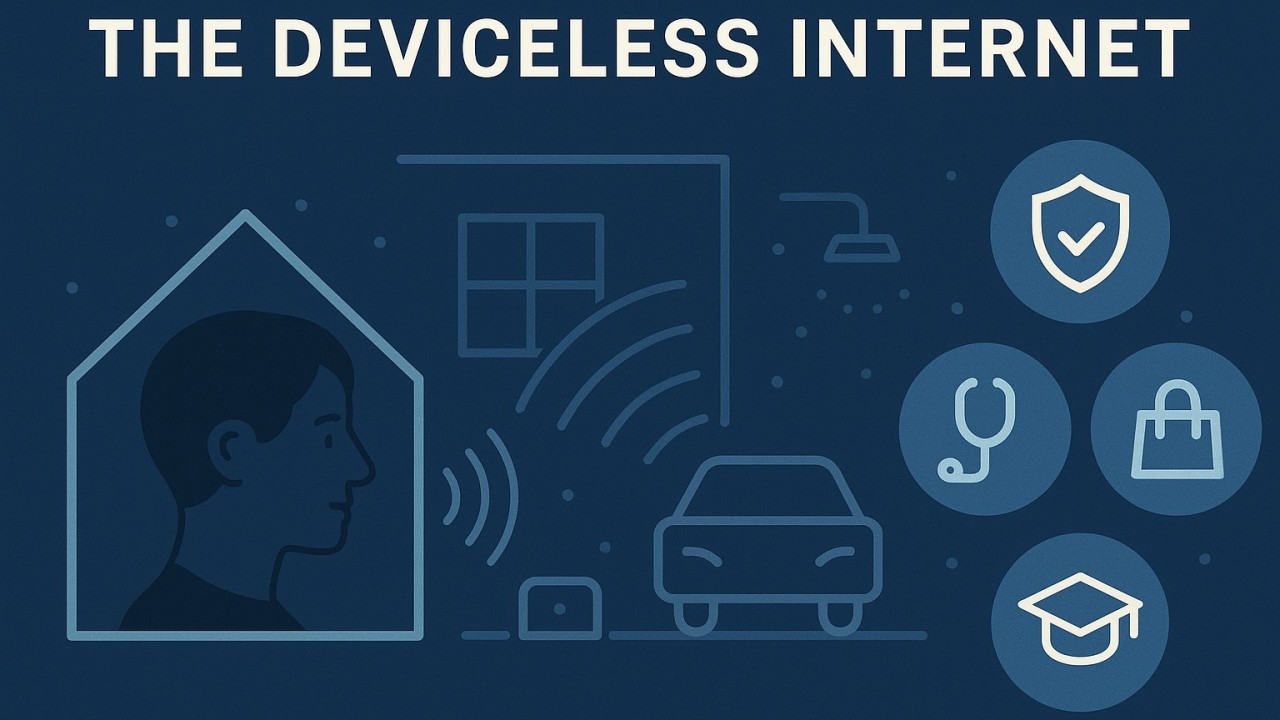
What if the next form of the Internet didn’t live in our phones, laptops, or watches, but in the air around us? Not only in our devices, but in the walls of our homes, the dashboards of our cars, the architecture of our public spaces, quietly listening, invisibly present, always ready to act.
This isn’t a product announcement. It’s a vision.
A near-future where devices are no longer the gateway to the Internet, but simply one of many possible tools, used only when absolutely necessary. For most, interaction with technology will happen without touching anything.
No screen. No tap. No keyboard. Just voice, presence, and trust. Welcome to what I call the Deviceless Internet.
From Devices to Surroundings
Today, our digital interactions are filtered through a device-centric model. We pick up a phone. We log in. We speak to a piece of glass.
But what happens when voice becomes the interface? When your voiceprint replaces your password? When you walk into a room and that room already knows what you need, because your personal AI agent is already negotiating on your behalf?
Imagine stepping into your hotel room and finding that your Travel Agent has already set the temperature to your preferred setting, even before you checked in at the hotel desk office. Or getting into your car, and your Mobility Agent has already rerouted your path because of a road accident nearby. Or entering a government building, and your Citizen Services Agent has checked you in, verified your ID, and retrieved the forms before you even approach the desk.
None of this requires holding or activating a device. The interaction is ambient. The intelligence is distributed. And the agents? They are personal, programmable, and often mandated by the very society we live in.
Agents by Design, Not Just by Download
In this vision of the Deviceless Internet, we don’t just “install apps.” We are accompanied by agents, digital counterparts that manage, mediate, and advocate for our needs.
Some agents would be provided by public authorities, assigned at birth, or just as we receive social IDs or passports:
- A Health Agent, integrated with national health systems
- An Education Agent, managing learning records across a lifetime
- A Public Safety Agent, responding in emergencies or disaster alerts
These public agents become part of our civic infrastructure.
Beyond that, each of us would have the freedom to add agents, to rent or own them depending on the needs of the moment:
- Hire a Tax Optimization Agent for three weeks every spring
- Lease a Travel Agent for a month-long trip to another continent
- Subscribe to a Wellness Agent that coordinates sleep, fitness, and mental health routines
These agents aren’t websites or apps. They’re autonomous service proxies, designed to act on your behalf, learn from your preferences, and protect your time.
But What If You Don’t Have a Voice?
In a future built on voice-first interfaces, we must confront an uncomfortable truth: not everyone speaks. Not everyone hears. And not everyone communicates through voice.
The Deviceless Internet, if it is to be worthy of its name, must be inclusive by design, not by afterthought.
Users with speech impairments or nonverbal communication styles must have equal access. That means building multi-modal input systems that respond not only to voice, but to:
- Eye movement and gaze detection
- Haptic taps on nearby surfaces
- Gesture recognition through ambient sensors
- Facial expressions or body movement patterns
- Sign language interfaces powered by embedded cameras
Authentication, too, must move beyond vocal biometrics: think gait recognition, heartbeat rhythm, or even neural signal patterns as future ambient keys.
Some users may co-manage their agents with trusted caregivers or proxies, enabled through consensual co-agency frameworks. Others may rely on silent input protocols, built into the same ambient systems designed for the vocal user.
To support this vision, we’ll need to establish new Agent Accessibility Standards, much like how WCAG reshaped the web. Every public or private agent should come with at least two input modes, and declare which populations it supports or excludes.
Because ambient doesn’t mean exclusive. It means present for everyone.
The Shift to Ambient Trust
For the Deviceless Internet to succeed, it must be built on trust and governance, not just on technology.
- Who secures your voiceprint, or your gesture profile?
- How do we prevent ambient exploitation or surveillance?
- What happens when agents fail or act against your interests?
- Can your government-funded agent be used as evidence against you?
- How do we ensure equity for those who cannot afford commercial agents?
These are not small questions. They are constitutional to the world we’re building. Just as we built rights and standards around the Web and mobile ecosystems, we must design for agency, consent, and dignity in this ambient, agentic future.
Why It Matters
We are moving rapidly into a world shaped not by interfaces, but by intents.
The Agentic Web is beginning to form. Autonomous systems are being deployed in ways that go far beyond automation; they are becoming representatives of our will. But the tools we use to interact with them remain stuck in old metaphors.
We still unlock rectangles to type into rectangles.
The Deviceless Internet invites us to move beyond that, to ask: What if the Internet was no longer something we visited, but something that visited us?
This future won’t appear all at once, but it’s approaching faster than we realize. The question is not if it will happen, but who will shape it. We can help build it, or live with the consequences of not being part of its design.