Humanoid Robots and the Rise of the Internet of AI Agents
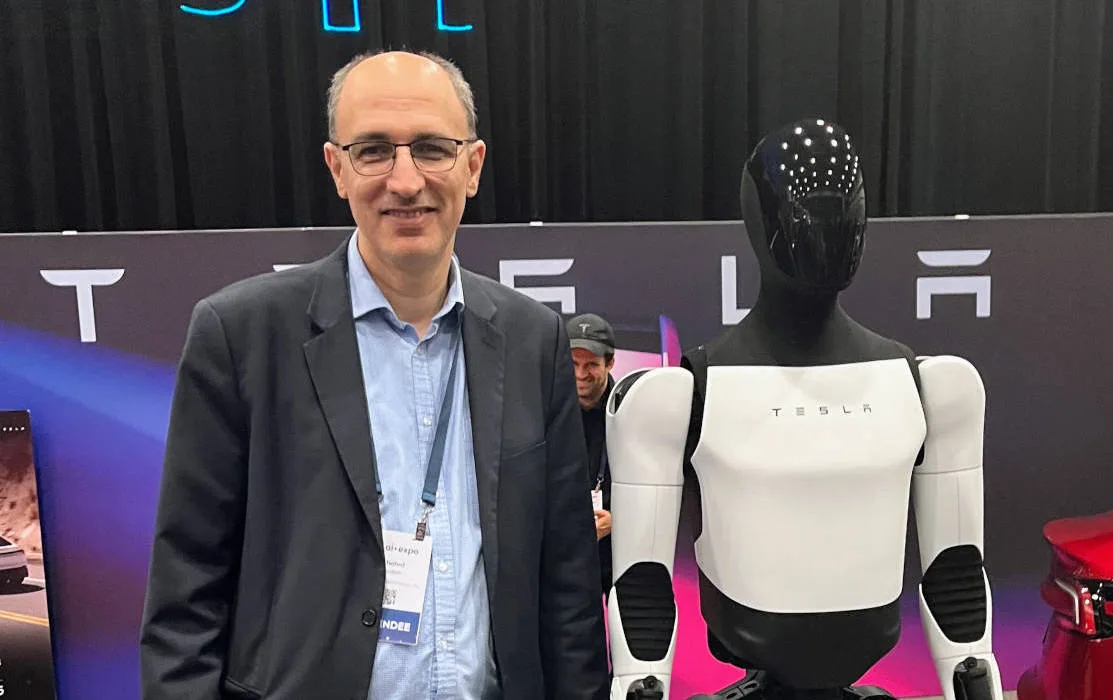
Standing next to a humanoid robot no longer feels like an encounter with distant science fiction. It increasingly feels like an encounter with the next layer of digital infrastructure.
For decades, the Internet connected computers, then mobile devices, then billions of sensors and connected objects through what became known as the Internet of Things. A new transition is now emerging, one that may prove even more consequential: the rise of autonomous AI agents operating across both digital and physical environments.
In his recent article, “The 7 Phases of the Internet: A Map to Where the Web Goes Next,” Vint Cerf describes this transition as the “Internet of AI Agents.”
His framing is important because it shifts the discussion away from AI as a standalone tool and toward AI as a networked operational ecosystem.
As Vint Cerf explains, the next generation of systems will not simply transmit information or execute predefined instructions. These agents will increasingly perceive, reason, act, coordinate, and collaborate in real time across distributed networks.
He distinguishes between two major categories:
Digital AI agents, such as coding copilots, workflow orchestrators, digital assistants, and algorithmic systems operating entirely in digital environments.
Physical AI agents, including autonomous vehicles, drones, industrial robots, medical systems, and humanoid robots operating simultaneously across digital and physical domains.
Humanoid robotics represents one of the clearest and most visible manifestations of this transition.
These systems are no longer limited to repetitive industrial automation. They increasingly combine mobility, perception, natural language interaction, adaptive learning, and autonomous task execution within a single platform.
The significance of this shift became particularly visible in January 2026 when Tesla announced a major strategic reallocation of industrial capacity.
Tesla stated that it would discontinue production of the Model S and Model X vehicles and convert part of its Fremont factory into a large-scale manufacturing facility dedicated to Optimus humanoid robots. According to the company, the facility could eventually produce up to 1 million robots annually.
Elon Musk described the upcoming “Optimus 3” generation as a general-purpose robot capable of learning tasks by observing human behavior, understanding verbal instructions, and even interpreting video demonstrations.
Whether or not Tesla fully achieves these ambitions within the announced timelines is not the central point.
The strategic signal itself matters.
One of the world’s most advanced manufacturing companies is reallocating factory space previously dedicated to premium electric vehicles toward humanoid AI agents. That decision reflects a growing belief that autonomous agents may become a foundational economic layer of the next decade.
This transition resembles earlier Internet inflection points.
At one stage, websites were viewed as optional.
Later, mobile applications became mandatory operational interfaces.
Today, AI agents are beginning to evolve from experimental tools into operational actors.
The critical difference is that these agents will not function in isolation.
A humanoid robot operating in a warehouse, airport, hospital, retail environment, or logistics center will continuously interact with cloud-based AI models, enterprise systems, autonomous vehicles, IoT infrastructure, digital identity systems, and eventually other AI agents.
The resulting value will emerge from networked coordination rather than isolated intelligence.
This is precisely why the phrase “Internet of AI Agents” is strategically significant.
The future is not simply about intelligent machines.
It is about interconnected autonomous systems participating in economic and operational ecosystems.
That evolution also introduces governance challenges that remain largely unresolved.
When AI systems move from screens into physical environments, trust can no longer remain an abstract principle or a marketing slogan.
Questions of identity, accountability, authority, oversight, interoperability, auditability, and interruptibility become infrastructure-level requirements.
Who is responsible when autonomous agents coordinate actions?
How are permissions delegated?
How are harmful actions interrupted?
How are agents authenticated across networks?
How do institutions preserve meaningful human authority when decision-making becomes increasingly distributed across machine systems?
These are no longer theoretical policy discussions.
They are emerging operational requirements for governments, companies, infrastructure operators, and standards organizations.
The future challenge therefore extends beyond building capable AI agents.
The deeper challenge is building governable AI agents operating within trustworthy institutional and technical frameworks.
This is where discussions around AI governance, digital identity, oversight models, and interoperability standards become central rather than peripheral.
The Internet connected computers.
The mobile Internet connected people.
The Internet of Things connected devices.
The next phase may connect autonomous actors capable of interacting, coordinating, and making decisions across both digital and physical worlds.
That transition is no longer hypothetical.
It has already begun.